
Sangpuy: Ancient Tunes of Today
Sangpuy’s voice carries generations of ancestral chants once sung across the plains and mountains of Taiwan, bridging spirit of the past with the heartbeat of the present.
Sense of Wander: ★★★★☆

Sangpuy, one of Taiwan’s most acclaimed indigenous singers, presented his concert Flowing Boundaries in Taipei this October.
TAIPEI, Taiwan — When Sangpuy steps onto the stage, time softens. His deep, resonant voice carries generations of ancestral chants once sung across the plains and mountains of Taiwan. Yet his music is not bound to nostalgia but an act of continuation. His songs are not just melodies, but stories.
As part of the Artquake in Autumn festival, the Indigenous singer from the southern tip of Taiwan presented his concert Sangpuy: Flowing Boundaries — Songs of Land, Faith, and Memory at the National Concert Hall in Taipei.
The evening opens with ancient tribal chants. His voice, expansive and powerful, seems to lift the audience out of the auditorium’s shoebox hall, transporting us into distant mountain ranges where space sees no limit.
Rooted in the traditions of the Pinuyumayan people, Sangpuy often turns to ancient tunes passed down by his ancestors — especially in times of hardship. Through these songs, he finds comfort. This makes me reflect on how easily we city dwellers — living lives so often consumed by work and materialism — can grow distant from our own roots. I can’t help but wonder: how grounding would it be to have something so timeless to hold on to when life becomes turbulent?
Alongside ancestral invocations, Sangpuy also performs songs written for the gospels. Catholicism was introduced to Taiwan in the 20th century, and many Indigenous communities still embrace it today. It is a strange yet comforting sight to witness tribal shamanic beliefs and foreign religions coexist side by side. Whether ancient chants or Catholic hymns, all are sung in the Pinuyumayan language, opening a space where ancestral voices continue to speak, offering guidance, resilience, and a sense of belonging in the present day.
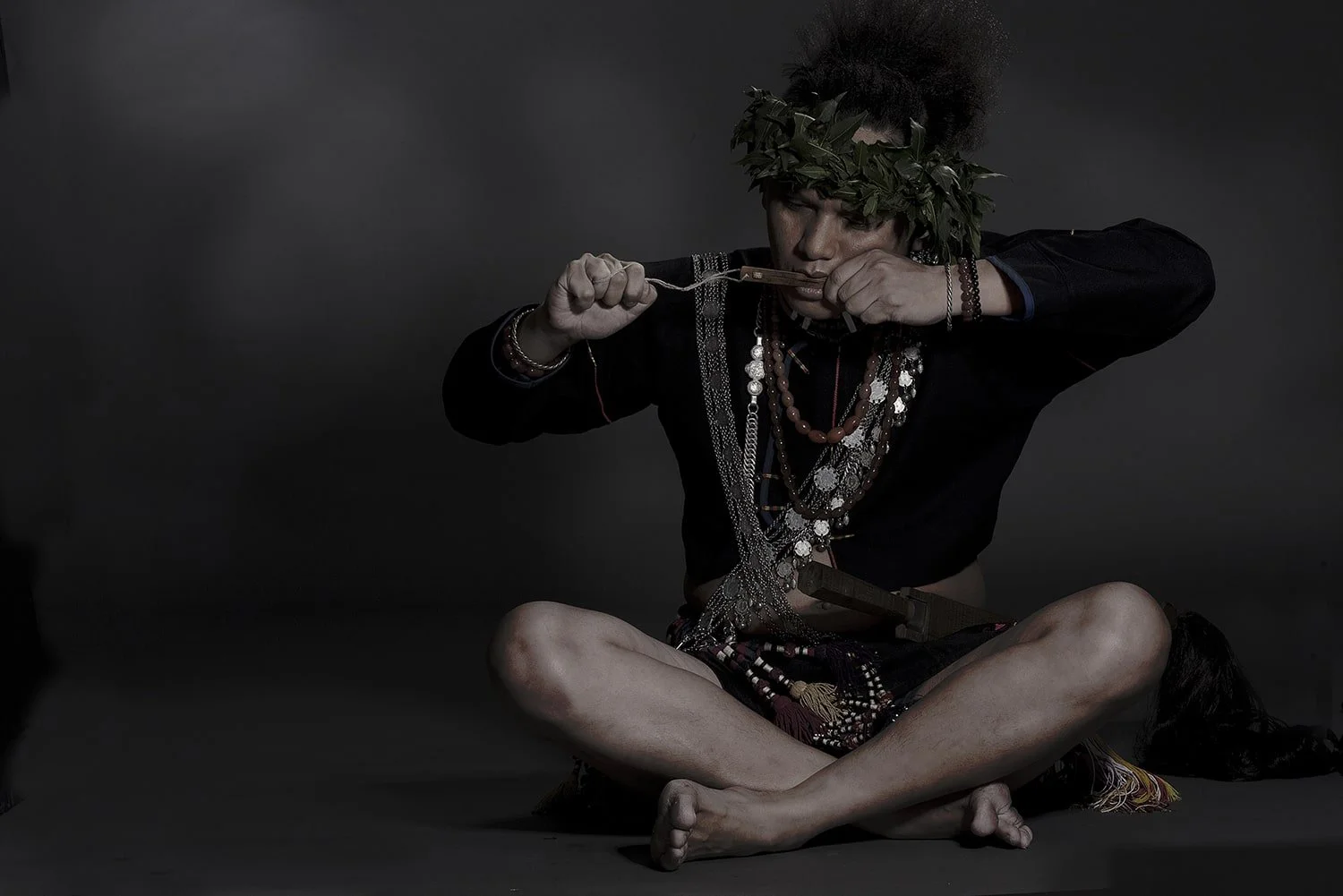
Sangpuy performing on the bamboo jaw harp. Image from internet.
Certain instruments are closely associated with Indigenous music, and Sangpuy brings several of them to life. He first plays a nose flute from South America, marveling at how similar it sounds to those from Taiwan despite the vast distance between their origins. He then plays a Taiwanese nose flute, humorously noting that he borrowed it from Taitung’s National Museum of Prehistory for only 25 NTD, “because it always just sits inside a glass case.”
He also performs on the jaw harp, a traditional instrument made from bamboo with a flexible reed. Its elastic, almost rubber-band-like sound is what he calls “the electric music of old times.” This humble instrument reveals ancestral wisdom hidden in the simplest materials.
Sangpuy doesn’t simply sing; he tells stories — stories of his tribe, his ancestors, and the land he calls home. One powerful moment comes with Tune of Hunting Cattle (Shouniudiao), a song that traces the migration of his fellow tribesmen to Manchou in southwest Taiwan for trade, and how they eventually settle there. It is also the only song in the concert sung in Taiwanese.
Sangpuy’s vision is to create “ancient tunes of today.” Just as the songs of his ancestors once guided him, he now writes pieces dedicated to ancestral spirits, to the cosmos, and to nature itself.
While performing works inspired by forests, wind, earth, and the elements, he shares the Pinuyumayan worldview: humans do not stand above nature but live among it. “We were taught from an early age that humans were the last to be created,” he says. “So we must love our environment. The animals are our cousins.”
Perhaps this is why his music carries such humility. While we city dwellers often treat nature as something to take advantage of or escape to, Sangpuy’s songs feel like whispers to wind and stone, as if they were lifelong companions.
“We see nature differently — even earthquakes and typhoons are a blessing.” This is a worldview far from life in the concrete jungle, where nature is appreciated only when convenient: sunshine, clear skies, and little else.
Besides being a singer, Sangpuy grows mangoes with his mother back home. In his early twenties, he sold his CD albums to raise donations after the devastating 921 earthquake in central Taiwan. He has also long been an advocate for Indigenous land rights.
In one of his compositions, Dalan — meaning “Road” — he encourages audiences to keep moving forward without fear, and to stay hopeful. His voice carries a rare quality, like a call sent from the heart toward something vast and unseen.
Listening to Sangpuy’s music feels like undergoing a kind of therapy — one that cuts through the layers of pride and defensiveness we accumulate in the rush of everyday life. His melodies remind us to move through the world with care rather than fear, with groundedness rather than ego. They remind us that kindness is not a weakness — it never puts us at a disadvantage.
Some of you may ask: how does one understand a concert sung entirely in an Indigenous language, without subtitles? It’s true that I understood none of the words. But what moves us most deeply is often the intangible — the things that bypass language altogether.
As music critic Shihfang Ma shared in the pre-concert talk, Sangpuy’s concert — built around themes of faith, migration, and coexistence — reflects the shared histories of Taiwan’s land and its people. Ultimately, it brings us back to the timeless questions we all must face: Who am I? Where do I come from? Where am I going?
Sangpuy: Flowing Boundaries — Songs of Land, Faith, and Memory was held at the National Concert Hall in Taipei, Taiwan, on October 16, 2025.